
Protests and state security forces’ reactions have escalated dramatically according to reporting from The Times and WaPo.
Human rights groups monitoring the situation in Iran despite state-ordered Internet and international telephone outages estimate protesters’ deaths ranging from 200 to 500. A New York-based concern reported receiving eyewitness accounts of hundreds of deaths since Thursday night. Hospitals are overwhelmed, with medical staff confirming reports of protesters being shot in the eyes by security forces. 1, 2
The U.S. is apparently considering a range of options to pressure the government regime, including military action, cyberattacks, and additional economic sanctions. Iran continues to blame both the United States and Israel for influencing the unrest. Iran’s Parliament Speaker Mohammad Baqer Qalibaf was quoted on Telegram saying that, if attacked, Iran could target Israel, the U.S., and shipping lanes.3
Clearly the Venezuela operation and related oil grab is fresh on the minds of Iranian leadership. Iran is the world’s seventh largest oil producer, supplying four million barrels per day. It is estimated to have ten percent of all global oil reserves within its borders. 4
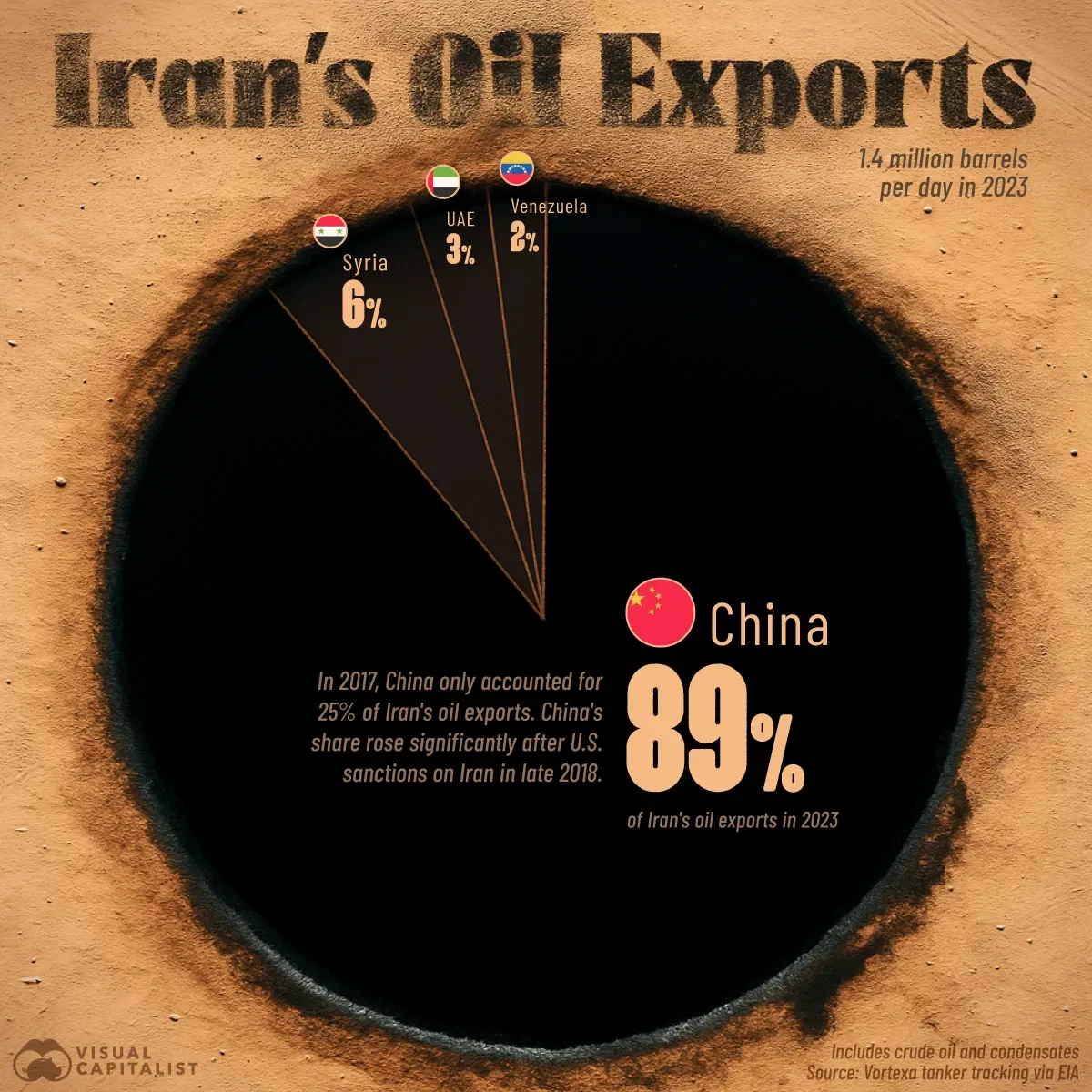
Even more frightening to the Iranian government should be that the seizure of Venezuelan oil denies China access to that crude. This makes Iran an even more tempting military target, because China is Iran’s top oil purchaser. 5
In comparison to Venezuelan crude, most of Iran’s crude is lighter and not as sour, though still characterized as a sour crude. That seems to mean that American companies, already equipped to process Venezuelan crude, should have no trouble refining the Iranian crude too. 6
It seems to me the Trump White House would absolutely entertain every available advantage over the CCP at the negotiating table. And with Iran already in a weakened state from its 12-day war with Israel earlier in 2025, Iran may not be well positioned to make good on its threats against either Israel or the United States via direct, military means. I wouldn’t be surprised if the U.S. was coordinating with Israel on intelligence and potential targets for air strikes. 7
For its part, China imports about 15% of its oil from Iran, and 5 – 7% from Venezuela. A Trump Administration decision to take over Iran’s oil industry would be met with significant resistance from China — but the U.S. could control 20% of the oil destined for the PRC. The U.S. has a $300 BB USD trade deficit with China — our largest by far — meaning we need them as a trade partner far more than they need us (assuming oil continues to flow from Iran and Venezuela). The U.S. imported $100 BB USD in computers and networking equipment in 2024. 8
Whether considerations such as these will be enough to dissuade the Trump White House from going as far as to seize Iran’s oil industry remains to be seen. “Cooler heads” hasn’t seemed a familiar term to this administration.
- Solomon, E., & Mahoozi, S. (2026, January 11). As Death Toll Surges in Iran, Leaders Take Tough Line Against Protesters. The New York Times. Retrieved January 11, 2026, from https://www.nytimes.com/2026/01/11/world/middleeast/iran-president-protests-economy-response.html ↩︎
- Torbati, Y. (2026, January 11). ‘Massacre’ feared as Iran tries to crush protests; U.S. weighs military options. The Washington Post. Retrieved January 11, 2026, from https://www.washingtonpost.com/world/2026/01/11/iran-protests-death-toll/ ↩︎
- Ibid. ↩︎
- Iran oil reserves, production and consumption statistics – Worldometer. (n.d.). Worldometer. https://www.worldometers.info/oil/iran-oil/ ↩︎
- China is by far the top buyer of Iranian oil. (2025, June 24). Voronoi. Retrieved January 11, 2026, from https://www.voronoiapp.com/natural-resources/China-Is-By-Far-the-Top-Buyer-of-Iranian-Oil—-5544 ↩︎
- The upstream oil and gas industry in Iran. (n.d.). https://www.energy-cg.com/OPEC/Iran/Iran_OilGas_Industry.html ↩︎
- Wikipedia contributors. (2026b, January 11). Iran–Israel war – Wikipedia. https://en.wikipedia.org/wiki/Iran%E2%80%93Israel_war ↩︎
- López, D., & Galán, J., (2025, April 11). Five charts that explain the US-China trade relationship. EL PAÍS English. https://english.elpais.com/economy-and-business/2025-04-11/five-charts-that-explain-the-us-china-trade-relationship.html ↩︎
Leave a Reply